Knowledge
Simplify Cryptocurrency Off-Ramping with Native Flow Integration
Native flow is an off-ramp feature that improves your app’s user experience. Read on to learn how it works and when you can implement it.
Native flow is an off-ramp feature that improves your app’s user experience. Read on to learn how it works and when you can implement it.


We recently launched a global off-ramp service to help your users jump from crypto to fiat as easily as they jumped into web3 with Ramp Network.
Taking it to the next level, you can now implement the off-ramp native flow to give your users a seamless, two-way experience to and from web3 - without them ever leaving your app.
There are two types of user flow implementations for our off-ramp product:
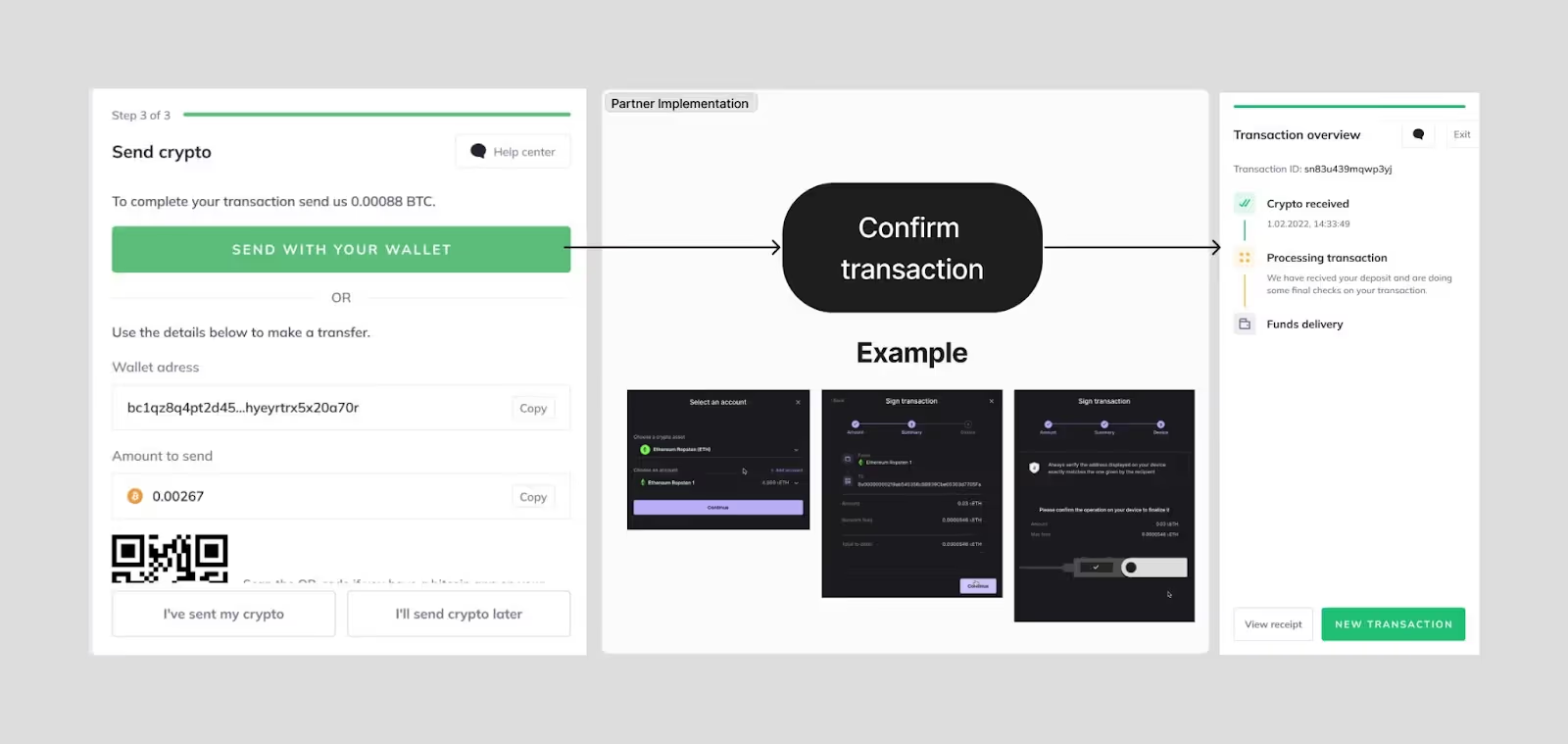
Users can create AND execute the transaction directly from inside your app (i.e. from your app’s built-in wallet) when selling their crypto.
The transaction is created and handled by your app’s native wallet, with pre-filled data (wallet address, amount, asset type), and sent directly to the right destination address, reducing the potential for errors and keeping the experience unbroken.
We highly recommend that you implement native flow if your app allows for it, as it gives your users a much-improved experience than a manual flow.
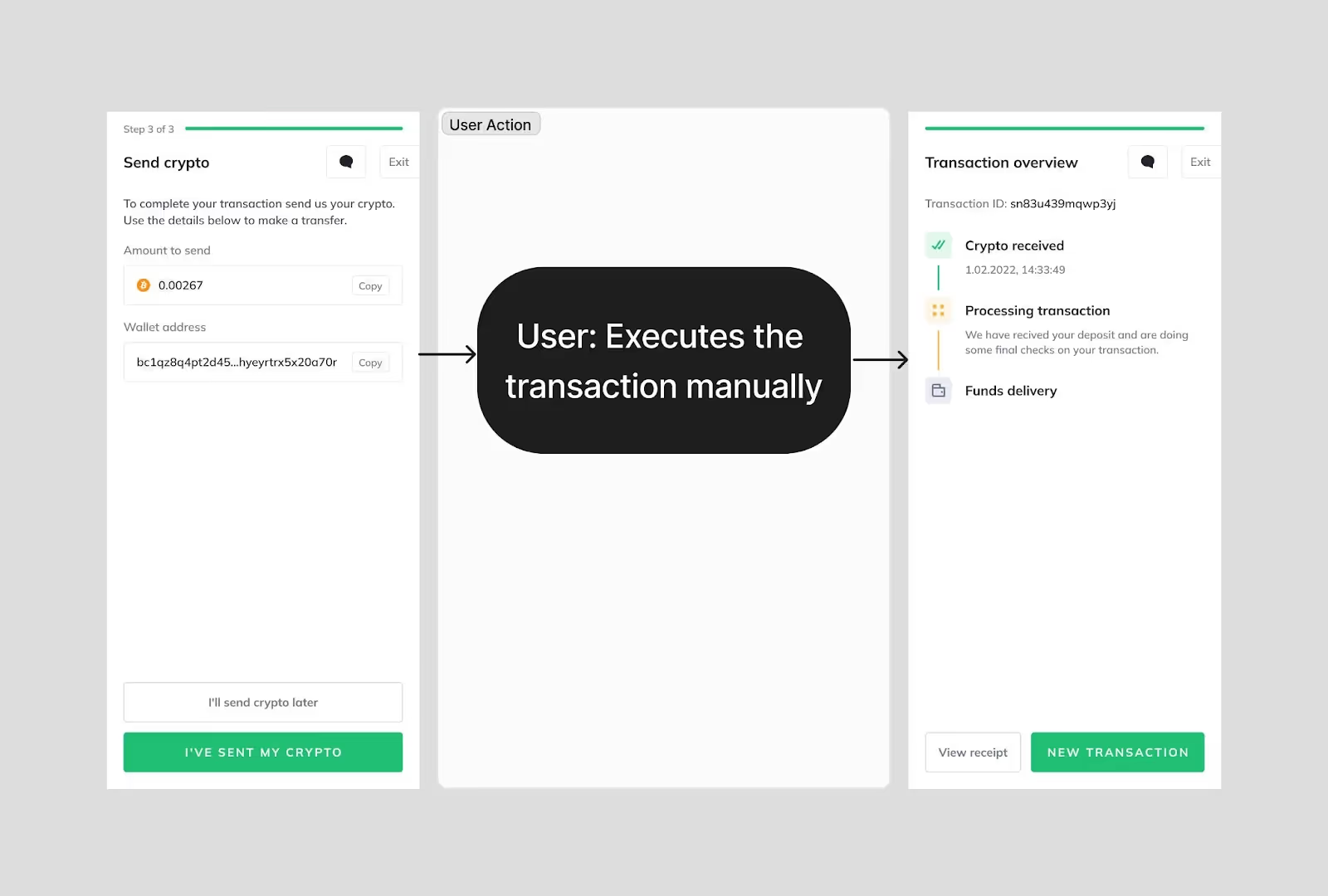
Users can initiate the sale within your app, but must use an external wallet to complete the transaction. This option adds friction to the experience - as well as being error-prone, since users must manually copy and paste the transaction information.
Let’s take a look at why you should consider native flow over a manual flow:
The question of whether or not the off-ramp native flow is available to you depends on two factors: your application capabilities, and the type of integration you have in place. For some types of applications/integrations, native flow is required, whereas for others, it’s optional or not available.
Native flow integration is required if your app is a native mobile app that can execute crypto transfers, such as mobile-only crypto wallets, or mobile web3 apps with built-in wallet capabilities.
Since these types of apps can handle transactions on the user’s behalf, the native flow is required in order to keep the experience unbroken - as it wouldn’t make sense for a user to complete the transfer externally in this situation.
We highly recommend native flow integration for apps that have the capability to execute crypto transfer, but in which it’s feasible for a user to execute the transfer manually with an external wallet.
This includes desktop browser-only or desktop browser-first web3 applications that have the overlay or embedded integration types.
If your application doesn’t have a built-in wallet or wallet-like capabilities (i.e. your app can’t execute transactions on behalf of your users), then it won’t make sense to implement native flow, as your app won’t have the means to execute the crypto transaction.
Also, if you’ve implemented the web hosted integration type, you won’t be able to take advantage of native flow, since the flow of the transaction already takes place outside your app.
For off-ramp, we recommend native flow over manual flow whenever applicable. Here are reasons why:
Implementing the off-ramp native flow is easy, even if it takes slightly more effort than manual flow. You can find all the details to implement the native flow in our developer documentation.
That’s it. Integrating off-ramp into your application is as simple as that.
If you’re ready to get started and enable native flow into your existing Ramp Network integration, check out the documentation for more information. You’ll find a detailed explanation for integrating in web with SDK, iOS with SDK, and Android with SDK as well as the corresponding non-SDK routes.
We’re looking forward to welcoming you to the Ramp Network family along with hundreds of thriving web3 projects, and to helping your business grow.
Haven’t integrated yet? Click the button below to apply for a partnership and get started!




Ramp Swaps Ltd
Ramp Swaps Limited is a company registered in England and Wales under the company number 11850124, and registered with the UK Financial Conduct Authority (FCA) as a cryptoasset business. Ramp Swaps Ltd's office address is 81 Rivington Street, London EC2A 3AY.
Ramp Swaps (Ireland) Ltd
Ramp Swaps (Ireland) Limited trading as Ramp Network is regulated by the Central Bank of Ireland. Ramp Swaps (Ireland) Limited is a private limited company, with its registered office at 6th Floor, 2 Grand Canal Square, Dublin 2, D02 A342 and registered no. 739533.
Ramp Swaps LLC
Ramp Swaps is a limited liability company (LLC), registered as a money services business (MSB) with the U.S. Department of the Treasury's Financial Crimes Enforcement Network (FinCEN). Ramp Swaps LLC's office address is 333 S. E. 2nd Avenue, Suite 2000, Miami, FL 33131. NMLS ID 2366547
Warning for Using self-custodial wallet: The provision of this service does not require licensing, registration or authorisation by the Central Bank of Ireland, and as a result is not covered by the Central Bank of Ireland rules designed to protect consumers or by a statutory compensation scheme.
Warning for Top up, Buy or Sell: If you invest in this product, you may lose some, or all, of the money you invest.
Warning for Top up, Buy or Sell: The value of your investment may go down as well as up.
Warning for Top up, Buy or Sell: Past performance is not a reliable guide to future performance.
Swaps are not available in the EU.